ReproducibiliTea Leuven
  • Home
  • Sessions
  • Organizing Team

ReproducibiliTea Leuven Sessions

Upcoming Sessions

Let's Play Open Science Games
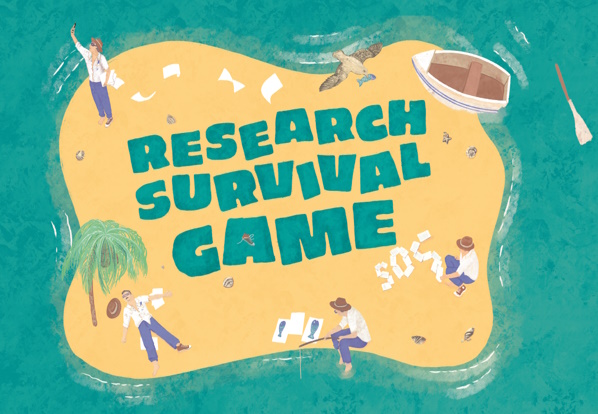
Start the new academic year with a special ReproducibiliTea session featuring the Research Survival Game, developed by KU Leuven Libraries. In this interactive board game, players take on the role of researchers navigating the research landscape, learning about topics such as Open Access, Research Data Management, and good research practices along the way. Through questions, discussion, and a bit of friendly competition, participants will explore key concepts relevant to responsible and open research. Whether you're new to ReproducibiliTea or a familiar face, join us for a fun and engaging start to the year. Resource: https://bib.kuleuven.be/english/research/researchsurvivalgame
October 20, 2026 at 16:00
VHI 03.64
Register

Open Science in the Humanities
Open science ideals, largely derived from the "hard sciences", have seen significant success, but research in the arts and humanities often struggles to meet goals of transparency and reproducibility. This discrepancy arises from different scholarly customs and challenges inherent to diverse fields. Some propose the concept of Open Humanities to tailor Open Science ideals to the arts and humanities, while others advocate for a broader Open Research framework that encompasses all disciplines. The aim is to develop a shared understanding of Open Research's implications across various fields, addressing the unique challenges presented by each. Recommended reading: Paul Longley Arthur & Lydia Hearn, Toward Open Research: A Narrative Review of the Challenges and Opportunities for Open Humanities in Journal of Communication 71 (nr. 5, 2021), pp. 827-853. https://doi.org/10.1093/joc/jqab028
November 24, 2026 at 16:15
MSI 01.20
Guest Speaker: Brecht Liefsoens
Register

Is There Only One Correct Analysis?
Multiverse analyses have emerged as a prominent approach for addressing researcher degrees of freedom and evaluating the robustness of empirical findings. In this ReproducibiliTea journal club, we will discuss two pre-prints that offer complementary perspectives on the role of multiverse analyses in scientific research. The discussion will focus on the benefits and limitations of multiverse analyses, whether robustness across multiple specifications provides stronger evidence, and how researchers can balance transparency with theoretical and methodological justification. References: Lakens, D., Rasti, S., & Tunç, M. N. (2026). There is only one correct analysis. PsyArXiv. https://osf.io/preprints/psyarxiv/hvjxf_v1/ Nepomuceno, A., Ghosal, A., Sandoval-Lentisco, A., & Ioannidis, J. P. A. (2026). Uptake and Implementation of Multiverse-style Analyses Across 613 Studies. bioRxiv.
December 8, 2026 at 16:00
VHI 03.64
Peer-Ole Jacobsen
Register
No matching items

Past Sessions

Date Session Session leader
2026, May 27 Writing and sharing research code Guest speakers:
Marie Cloet and Márton Bognár
2026, March 18 On objectivity in science Jan-Peter Sandler
2025, November 18 Literature reviews reimagined Guest speaker: Pascale Maas
2025, October 7 Reflections on the reviewing process Peer-Ole Jacobsen
2025, May 6 Reproducibility made easy: Open resources for all disciplines Jan-Peter Sandler
2025, March 26 Between the quality and quantity of science Peer-Ole Jacobsen
2024, November 27 Generative AI and Open Science Eline Van Geert
2024, October 9 Open science interventions to improve reproducibility and replicability of research Guest speaker: Magdalena Kozula
2024, June 5 Crowdsourcing in research Benjamin Kunc
2024, March 27 Citizen science Benjamin Kunc
2023, May 23 The Chinese Open Science Network (COSN): Building an open science community from scratch Olivia Kirtley
2023, April 27 Redesign open science for Asia, Africa, and Latin America Benjamín Šimsa
2022, December 14 Fostering a research integrity culture Olivia Kirtley
2022, November 23 Methods over metrics Ginette Lafit
2022, October 25 Verification reports Benjamín Šimsa
2022, May 16 Implementing open science as a teacher/mentor Guest speaker: Sam Parsons
2022, April 26 Inclusivity and diversity in (open) science Olivia Kirtley
2022, March 31 Transparent data visualizations Eline Van Geert
2022, February 16 New topics in responsible research practices Aline Claesen
2021, November 16 Implementing open science as a research group Olivia Kirtley
2021, October 21 Implementing open science as an individual researcher Aline Claesen
2021, June 17 Open data Olivia Kirtley
2021, April 26 Open materials Eline Van Geert
2021, February 25 Preregistration Aline Claesen
2020, December 3 But, what if I was wrong? Olivia Kirtley
2020, October 29 How to deal with the problem? Aline Claesen
2020, February 27 What was the problem again? Pieter Moors
No matching items
ReproducibiliTea Leuven ©

Built with and Quarto